
By Eric Peters
There are several things that are unusual about the 2026 Land Rover Defender. One is that it’s available in multiple wheelbase lengths, two- and four-door body styles, and with seating for as few as five or as many as seven. Another is that it’s offered with four different engines, including two V8s alongside a turbocharged four-cylinder and turbocharged inline six.
Such variety was once common. Today, it’s almost extraordinary.
What it is
The Defender, which ranges from compact to full-size, is one of the original four-by-fours, alongside the first Ford Bronco. You’ve probably seen them on exploration shows because they can reach places most vehicles can’t. Today’s Defender remains rugged but is also ultra-luxurious — and, in some forms, astonishingly quick. Ordered with the available 626-horsepower turbocharged V8, it can accelerate like a Ferrari.
Prices start at $63,500 for the Defender 110 P300 S, a four-door, two-row model powered by a turbocharged 2.0-liter four-cylinder paired with an eight-speed automatic and full-time four-wheel drive with locking axles and Low range gearing.
The $73,000 Defender 130 P300 S rides on a longer wheelbase and adds a standard third row. Both the 110 and 130 can be upgraded with more powerful engines.
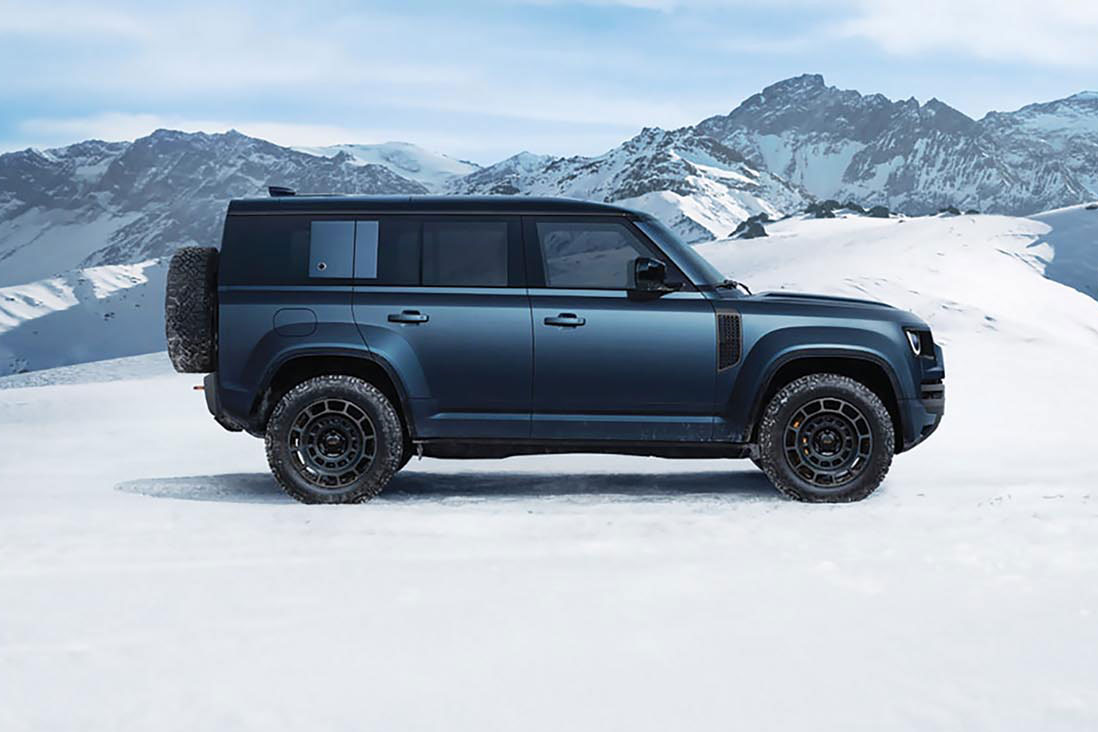
The 110 P400 Trophy Edition ($87,400) adds a turbocharged 3.0-liter inline six, all-terrain tires, adaptive suspension, raised air intake, roof rack and unique paint choices. The same engine is available in several 130 models, including the P400 X-Dynamic SE, Outbound and P400 X, the latter adding upgraded drive modes, recovery hooks, larger wheels and heated rear seating.
Buyers wanting a V8 can choose the two-door Defender 90 P525, which comes standard with a supercharged 5.0-liter V8. A turbocharged 4.4-liter V8 is standard in the 110 P635 OCTA ($158,300) and OCTA Black ($168,700), both of which feature widened fenders, upgraded air suspension and special seating. The Black adds unique wheels and dark-themed trim.
What’s new for 2026
A new Adaptive Off Road Cruise Control system automatically manages throttle input over rough terrain. The 130 can now be ordered with a built-in air compressor. Trophy and OCTA Black editions are new, and every Defender gets a larger 13.1-inch touchscreen.
What’s good
• Multiple body and engine choices.
• Heroic off-road capability.
• Available third row, unlike the Ford Bronco and Jeep Wrangler.
What’s not so good
• Steep price increases when moving up the engine lineup.
• Triple-digit fuel fill-ups are common.
• A similarly capable Ford Bronco starts tens of thousands less.
Under the hood
The standard engine is a turbocharged 2.0-liter four-cylinder producing 296 horsepower and 295 foot-pounds of torque. Like every Defender engine, it’s paired with an eight-speed automatic and full-time four-wheel drive with selectable terrain modes and Low range.
Despite its modest size, this engine allows the Defender to tow up to 7,716 pounds. It also returns an EPA-rated 18 mpg city and 22 mpg highway.
Available for those wanting more power is a turbocharged 3.0-liter inline six with a mild-hybrid system. It produces 395 horsepower and 406 foot-pounds of torque while delivering essentially the same fuel economy as the four-cylinder. Tow capacity rises to 8,200 pounds, making it the logical choice for buyers planning to tow heavier loads.
Beyond that are two V8 options. The supercharged 5.0-liter V8 produces either 493 horsepower (P500) or 518 horsepower (P525). The range-topping turbocharged 4.4-liter V8 develops 626 horsepower and 553 foot-pounds of torque. Equipped with the latter, the nearly three-ton Defender can reach 60 mph in about 3.7 seconds.
On the road
The four-cylinder is competent and the six is even better, but the available V8s are what make the Defender truly special.
Especially the supercharged 5.0-liter. It isn’t the most powerful engine in the lineup, but it offers something increasingly rare. Turbocharged engines are everywhere; superchargers are not. The payoff is immediate throttle response and a distinctive mechanical whir that enthusiasts will appreciate.
The Defender’s appeal, however, extends well beyond straight-line speed. Its real mission is going places other vehicles can’t. What makes it different is that it does so in luxury.
The fully independent suspension delivers both ride comfort and off-road articulation. OCTA models add Land Rover’s hydraulically linked 6D Dynamics suspension system for even greater capability.
With up to 11.5 inches of ground clearance, the Defender inspires enormous confidence when the pavement ends.
At the curb
Like a tailored suit, there’s a Defender to fit almost any buyer.
The two-door Defender 90 rides on a 101.9-inch wheelbase and measures 180.5 inches long. The four-door Defender 110 stretches to a 119-inch wheelbase and 197.5 inches overall. It can also be equipped with a third row, something neither the Bronco nor Wrangler offers.
Need more room? The Defender 130 measures 211.7 inches long and provides significantly more third-row space.
A clever available feature is a flip-up center console that converts into a front-row jump seat, allowing three passengers across the front.
Inside, the Defender blends luxury and utility. The digital instrument panel can be configured to display off-road information, while the new 13.1-inch touchscreen provides data such as elevation, incline angles and axle-lock status.
The bottom line
There are other four-by-fours that can match the Defender’s capability.
Few, if any, match its combination of capability, luxury and character.
Eric Peters has written for numerous publications including the Chicago Tribune, The Wall Street Journal and Investor’s Business Daily. In addition to test driving cars, Eric writes about classic cars and motorcycles. He owns a ’76 Pontiac Trans Am that has outlasted his marriage, and a number of weird old bikes.